Winter storm warning: use the hours before it starts
A warning is not a shopping alarm. It is a short decision window: read the local impacts, cancel avoidable travel, decide whether the home can stay safe without power, and close the most important gaps before snow or ice makes every task harder.
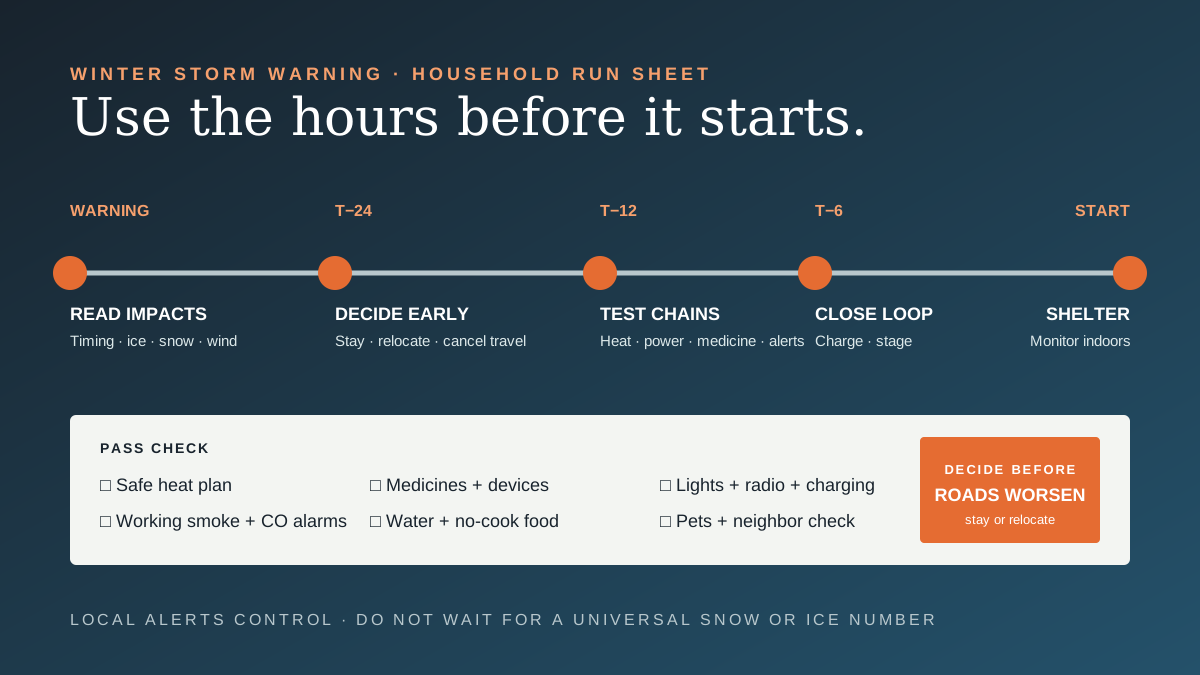
The National Weather Service says the main household concerns in a winter storm are loss of heat, power and phone service, plus supplies becoming hard to reach. Freezing rain adds a second clock: roads and walkways can become unsafe before much accumulation looks dramatic, while ice-loaded trees and lines can extend an outage after precipitation ends.
That is why the best warning checklist is ordered by decisions, not products. A battery, blanket or bag of food helps only if it is charged, accessible and assigned to the person or task that needs it. A backup heater helps only if it is approved for the location, installed and used exactly as directed. A relocation plan helps only if the destination is open and the trip happens while roads are still safe.
Public winter-storm discussions repeatedly ask what an all-electric apartment can do, whether to leave before an ice storm, what to charge, and how much gear to buy. Those are useful questions. The safe answer begins with the local impact forecast and the household's real constraints—not a copied shopping list.
Translate the warning into household impacts
Read the alert text from the local National Weather Service office. Copy the start and end times, precipitation type, expected snow or ice, wind, temperature trend, affected roads, and the warning's main instruction. Check the hourly forecast and any local emergency or utility notices. A winter storm warning, ice storm warning, blizzard warning and extreme cold warning describe different leading hazards.
| Forecast impact | Household consequence | Action before conditions worsen |
|---|---|---|
| Freezing rain or ice | Treacherous roads and walks; falling limbs; power-line damage | Finish travel early, park away from trees when lawful, stage lights and outage contacts |
| Heavy or blowing snow | Low visibility, delayed response, blocked doors or exterior vents | Cancel travel, identify a safe exit, move the shovel to an accessible sheltered spot |
| High wind | Faster heat loss, tree damage, drifting snow, utility interruption | Charge devices, secure only what can be reached safely, move people from rooms under suspect limbs |
| Dangerous cold | Hypothermia, frostbite, frozen plumbing, unsafe heating shortcuts | Set a warm-room and relocation trigger; follow local pipe guidance |
| Long duration | Medicine, food, water, pet and communication needs outlast routine supplies | Confirm quantities and destinations; do not assume delivery or fuel service will continue |
Do not average away uncertainty. If the alert gives a range or describes higher totals in part of the area, plan for the credible impact at the property. Recheck official updates on a schedule, but do not spend the entire warning window refreshing forecasts while tasks remain undone.
Make the stay-or-go decision before roads deteriorate
Ask one hard question first: can this home safely support every occupant if power, heat, water, elevators, phone service or road access fails? Consider infants, older adults, people with disabilities, mobility limits, temperature-sensitive medicine, home medical devices, pets and anyone who cannot tolerate a cold room.
Choose a relocation trigger in advance. Examples include an official evacuation instruction, no safe approved heat source, a medical device without sufficient backup, a home already losing heat, inaccessible exits, or a destination that requires travel before freezing rain begins. Confirm the destination, route, transport, accessibility, pet policy and whether it still has power and heat.
Do not wait for the lights to go out before starting a trip the warning was meant to prevent. FEMA's winter guidance says people under a winter storm warning should stay off roads and find shelter. If leaving is the safer choice, do it before that shelter-in-place phase and follow local instructions. If staying, write the point at which changing conditions would require local emergency help rather than a late road trip.
Safe heat plan, working alarms, supplies, communication, accessible exits and a realistic outage plan all pass.
A confirmed heated destination and safe transport exist, but the home fails a medical, heat, access or power requirement.
Local officials, utility, property manager, care team or emergency services must resolve a time-sensitive safety question.
T−24: assign the household plan
“Twenty-four hours” is an organizing frame, not a promise about alert lead time. If the warning arrives later, start at the first unfinished step and protect the travel cutoff. Divide work by person and require a simple pass result.
- Alerts: Enable local emergency alerts and utility outage notices. Put a battery radio beside the written frequency or station. Review the site's communication ladder and name an out-of-area contact.
- Heat: Record the normal heating fuel or electricity dependency. Test smoke and carbon-monoxide alarms by their instructions. Choose the room that will conserve heat and review the one-warm-room plan.
- Power: List only priority loads: communication, approved medical equipment, lighting and essential refrigeration. Test charged power banks and manufacturer-approved backups. Do not improvise building wiring.
- Medicine: Count essential doses, gather prescriptions and pharmacy or care-team contacts, and document storage requirements. Use the refrigerated-medicine plan for temperature-sensitive products.
- Water: Confirm drinking water and how the property's well pump, pressure system or building pumps behave without electricity. Follow any current water advisory. Keep clean containers accessible.
- Food: Set out no-cook foods that fit household dietary needs. Put appliance thermometers in the refrigerator and freezer, then plan to keep doors closed. Review the four-hour refrigerator and freezer clock.
- People and pets: Confirm warm clothing, bedding, infant items, pet food, medications, carriers, leashes and an indoor toileting plan where needed.
- Property: Follow local utility and building instructions for vulnerable pipes. Know the authorized shutoff and use the freeze-warning pipe plan rather than guessing which faucet to run.
T−12: test the chains, not just the objects
A flashlight in a drawer is an object. A light chain is a working flashlight in an agreed place, with charged batteries and a person who can reach it in the dark. Test each chain from warning to action.
Charge phones, mobility equipment, hearing devices, medical backups and power banks using their approved equipment. Download or print local contacts, the forecast, medication list and a neighborhood map. A phone at 100 percent is not the whole communication plan; network service and home internet may fail.
Stage headlamps or flashlights instead of relying on candles. Confirm that smoke and CO alarms have working backup power. CDC warns never to use a gas oven to heat the home and never to operate generators, grills, camp stoves or other outdoor combustion equipment indoors, in garages, carports or near openings.
If a portable generator is part of an established plan, use only the manufacturer-approved connection and a location outdoors at least 20 feet from windows, doors and vents, with exhaust directed away. Snow or freezing rain does not make a garage safe. Do not backfeed a wall outlet. Review the site's carbon-monoxide and generator plan before the storm.
Check exterior furnace, boiler, water-heater and dryer vents only from a safe location and according to the equipment instructions. Record where they are so accumulating snow can be assessed later without wandering outside blindly. Never climb on an icy roof or use a ladder during the storm.
T−6: close the loop and stop errands
Use the final safe hours to bring the plan inside. Move the shovel, ice-melt product, pet supplies and vehicle kit to places reachable without crossing a glazed walkway. Park lawfully away from weak-looking limbs when possible. Close and secure doors and windows. Do not touch, trim or approach trees near power lines.
- Recheck the official alert and local road or transit status.
- Cancel nonessential travel and tell the out-of-area contact where everyone will shelter.
- Put coats, boots, gloves, lights and the radio where they can be found without power.
- Fill clean containers only while the water utility says the supply is safe; do not use unapproved containers for drinking water.
- Set refrigerator and freezer rules: one person opens them only for a planned reason.
- Complete medicine refrigeration or device-backup steps from the care team and manufacturer.
- Bring pets indoors and make the last outdoor trip before ice or visibility worsens.
- Check on a nearby person only while travel and walking are safe; agree on a phone or text check-in afterward.
Stop when the outside task becomes riskier than the gap it would close. A last-minute fuel run, roof check or tree move is not worth a crash, fall or contact with an energized line.
When the storm starts, switch from setup to shelter
Stay indoors and follow emergency information. Dress in dry layers and consolidate in the planned room if heat fails. Watch the indoor temperature and the condition of people rather than waiting for discomfort to become an emergency. CDC advises knowing the signs of hypothermia and frostbite and seeking medical care when needed.
Report an outage through the utility's official channel. Keep away from downed lines and anything touching them; assume every line is energized. Do not go outside to inspect the neighborhood during freezing rain or poor visibility. Never use a vehicle, grill or generator as an indoor heat source.
Start written clocks for the outage, last known indoor temperature, refrigerator, freezer, medicine storage and check-ins. Keep refrigerator and freezer doors closed. If water service or safety changes, follow utility and public-health instructions; use bottled water or boil water only when the advisory tells you how.
If the home's temperature or a person's condition crosses the written trigger, contact local emergency services or warming-center resources. A warming center may have its own hours, access, transport and pet rules—verify them, do not assume. Do not begin an unsafe drive because an unverified social post says a destination is open.
After precipitation ends
The hazard is not over when the sky clears. Ice, hidden downed lines, falling limbs, blocked vents, unplowed roads and overexertion remain. Wait for local instructions, inspect only from a safe location and pace snow removal. CDC identifies overexertion as a winter-storm risk; people with health concerns should follow medical advice and avoid strenuous shoveling.
When power returns, follow utility and equipment directions. Check the food-safety and medicine records before using affected items. Do not assume a cold porch or snowbank kept food at a controlled safe temperature. Record which part of the plan failed while the details are fresh.
Renters and all-electric homes need a building answer
Ask property management, in writing, how the heating system, domestic water, elevators, garage doors, electronic entry, fire alarms and emergency lighting behave during an outage. Ask for the after-hours number and the building's relocation or warming plan. Do not alter wiring, plumbing, common-area doors or heating equipment without authorization.
An all-electric apartment does not become safer by bringing in a fuel-burning shortcut. Camp stoves, grills, patio heaters and generators stay outdoors and away from the building; many leases and local rules prohibit fuel storage or generator use. The practical backup may be early relocation to a confirmed heated place, plus charged lights, communication, medicine support and warm clothing for the transition.
Public discussions often focus on buying a portable power station. Capacity can be useful for supported devices, but it does not automatically run electric resistance heat, a heat pump, elevators or a building water system. Use device wattage, starting loads, manufacturer instructions and a qualified professional where needed. Never connect a power source to building wiring through a wall outlet.
Print the winter storm run sheet
Local impact
Alert type / issued: ___________________________________
Storm start / end: ____________________________________
Snow / ice / wind / cold: ______________________________
Travel cutoff: _________________________________________
Stay or relocate
Heated destination / confirmation: ______________________
Route / transport / pet access: _________________________
Relocation trigger: ____________________________________
Household chains
Alert + radio pass: ____________________________________
Heat + alarm pass: ____________________________________
Medicine + device pass: ________________________________
Water + food pass: ____________________________________
Pets + neighbor check: _________________________________
Out-of-area contact: ___________________________________
Post the sheet beside the lights and radio. Run a two-minute briefing: each person points to the safe heat room, lights, coats, emergency contacts and no-go outdoor areas. The test is complete when everyone knows the travel cutoff and the stay-or-relocate trigger.
Common winter warning questions
Is a warning the same as a forecast for a certain number of inches?
No. Warning types, criteria and expected impacts vary by hazard and location. Read the complete alert from the responsible NWS office and follow local instructions.
Should I drip every faucet?
There is no universal layout-independent answer. Follow the local water utility, property manager, plumber and building-specific plan for the vulnerable pipe run. Know the authorized shutoff.
Can I store food outside in the snow?
FEMA advises against using outdoor cold or snow as a substitute for controlled refrigeration. Outdoor temperatures vary and food can be exposed to contamination or animals. Use appliance thermometers and official food-safety guidance.
How much should I buy?
Start with the household duration and constraints in official guidance, then count what is already present. NWS and FEMA emphasize food requiring no cooking, water, medications, baby and pet needs, lights, radio and warm clothing. The plan should not depend on a costly one-day shopping trip.