Power outage food safety: a 4-hour fridge and 48-hour freezer plan
The hardest food decision after an outage is rarely whether the refrigerator feels cool. It is whether you can reconstruct time and temperature well enough to trust the food. Start a clock, keep the doors shut, and use a written decision path before anyone begins opening containers or tasting leftovers.
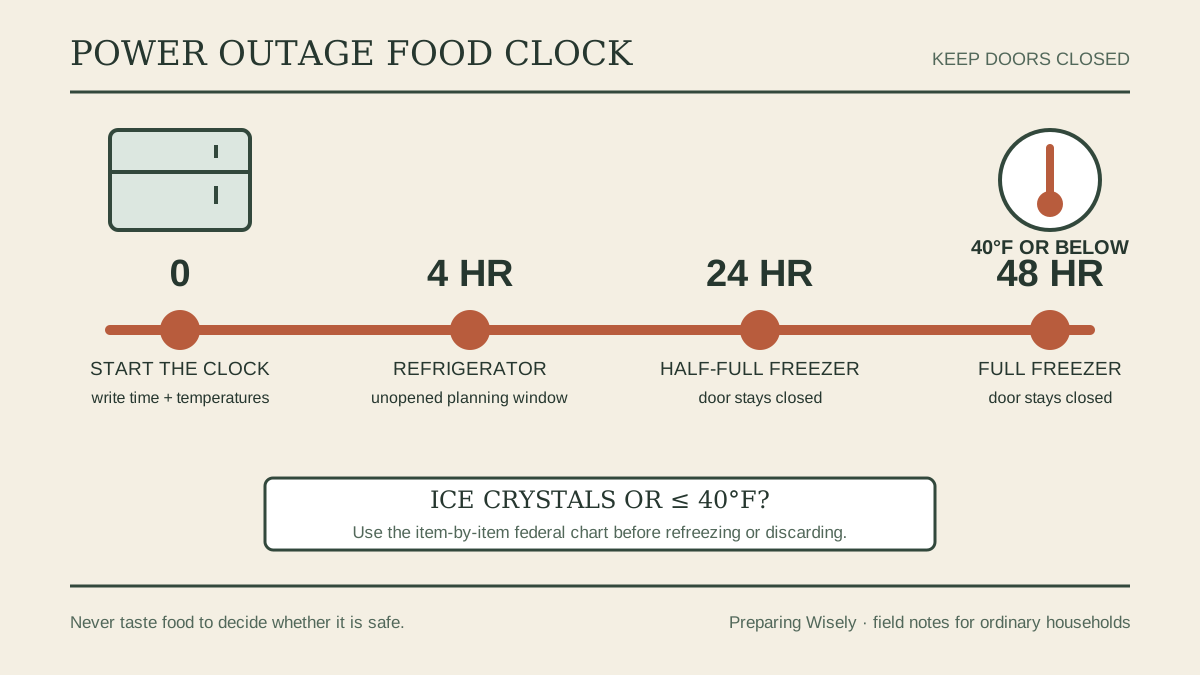
In the first minute, start a clock and close the doors
Write the outage start time where everyone can see it. If you do not know when power failed, use the last time you know the appliances were running and treat the missing interval conservatively. Photograph the refrigerator and freezer thermometers through the door if the display is visible. Then leave both doors closed.
FoodSafety.gov says an unopened refrigerator keeps food cold for about four hours. A full freezer holds temperature for about 48 hours; a half-full freezer for about 24 hours. Every unnecessary door opening shortens those windows. Make one person responsible for the food log so a child looking for a snack and an adult checking the freezer do not both spend the stored cold.
Outage start time, last known appliance temperatures, door openings, and any time food moves to a cooler.
Keep appliance doors closed. Use shelf-stable food first and keep a manual can opener with the outage pantry.
Check the utility estimate, but base food decisions on actual time and temperature rather than a changing restoration promise.
If the outage follows flooding, fire, or damage to the home, temperature is only one concern. Discard food touched by flood or storm water and follow local public-health instructions. If the refrigerator or freezer was damaged, contaminated, or exposed to smoke or chemicals, get event-specific guidance before salvaging food.
Use the four-hour refrigerator rule without inventing exceptions
During the first four hours, keep the refrigerator closed. If power returns within that period and the refrigerator stayed shut, FoodSafety.gov says the food should be safe. Check the appliance thermometer. A reading at or below 40°F supports keeping refrigerated food; a warm reading means you also need to know how long the food was above 40°F.
After four hours without power, discard refrigerated perishable foods unless you can verify that they remained at 40°F or below. The discard group includes meat, poultry, fish, eggs, milk, soft cheese, cut fruit, cooked vegetables, leftovers, soups, casseroles, deli meat, opened creamy dressings, and foods containing those ingredients. The official FoodSafety.gov chart gives item-by-item decisions and is better than a general guess.
The common “two-hour rule” and the “four-hour refrigerator window” answer different questions. The refrigerator may protect its contents for about four hours while closed. Once perishable food is above 40°F, FDA guidance uses a two-hour limit, shortened to one hour when ambient temperature is above 90°F. You need the time above 40°F, not just the total outage duration. When that history is unknown, discard the food.
Never taste food to decide. Odor and appearance cannot prove that a food is safe. Cooking also does not reliably repair every mistake because some hazards can remain after reheating. Write “do not taste” on the outage sheet so a well-meaning cleanup does not become the household’s test method.
Treat freezer capacity as a planning estimate, then inspect each package
A tightly packed freezer retains cold longer than a partly empty one. Plan around about 48 hours for a full freezer and 24 hours for a half-full freezer, assuming the door stays closed. Grouping frozen packages before storm season and filling empty space with frozen water containers can add thermal mass, but leave enough room for air circulation and never block appliance controls.
When power returns, check the freezer thermometer before moving food. If it reads 40°F or below, the food may be refrozen, although texture and quality can decline. Without a usable thermometer, inspect packages individually. Food that still contains ice crystals or is 40°F or below may be refrozen or cooked. Do not assume that a cold freezer wall proves every package stayed safe.
Some foods tolerate thawing better than others. Breads without custard fillings, flour, nuts, and many fruits may be kept or refrozen under conditions that would require discarding meat, seafood, dairy, casseroles, or frozen meals. Ice cream and frozen yogurt are special cases in the federal chart and should be discarded when thawed rather than refrozen. Use the chart for the exact food instead of applying one rule to the whole freezer.
Refreezing is a safety decision and a quality tradeoff. Thawed fruit may become soft, bread may dry out, and sauces may separate. Label refrozen packages with the outage date and plan to use quality-sensitive items soon. If a package leaked onto other food, separate it, clean the appliance, and prevent raw-meat juices from spreading.
Move food to a cooler only when the cooler can stay at 40°F or below
If the outage will extend beyond four hours, a cooler can protect a small set of high-value perishables, but only with enough ice or frozen gel packs to keep the contents at 40°F or below. Prepare the cooler, thermometer, ice, and food list before opening the refrigerator. One organized transfer is better than repeated searches.
- Choose the priority food: necessary dietary items, tomorrow’s meal, and the most expensive perishables you can actually keep cold. Keep refrigerated medicine in its separate documented plan.
- Prechill the cooler: if warning time allows, cool the empty container before loading and place a clean appliance thermometer inside.
- Pack cold on all sides: use ice or gel packs above and around food, keep raw meat leakproof and below ready-to-eat items, and fill air gaps where practical.
- Log the move: record the transfer time, starting temperature, and every temperature check. Add ice before the cooler rises above 40°F.
- Open with a list: keep the contents written on top so no one has to rummage. Return the lid promptly.
Dry ice can keep a freezer cold, but it requires protective gloves, ventilation, and careful handling. Never touch it with bare skin, seal it in an airtight container, or place it where carbon dioxide can accumulate. Follow the supplier’s instructions and official food-safety guidance. If you cannot manage it safely, use conventional ice and a smaller cooler plan.
Do not use a porch, snowbank, garage, or parked vehicle as an improvised refrigerator. Outdoor temperatures vary, sunlight warms containers, and animals or contaminated surfaces can reach food. FoodSafety.gov recommends making ice outdoors during a snowstorm and using that ice inside an appliance or cooler.
Print this time-and-temperature decision table
The table is a first screen. For an exact food, use the federal outage chart linked below. When the measured temperature and the remembered timeline disagree, use the more conservative result.
| What you know | What to do | Why |
|---|---|---|
| Refrigerator unopened; outage under 4 hours | Keep the door closed. Check the thermometer when power returns. | The closed appliance generally protects food for about four hours. |
| Refrigerated perishables after 4 hours; no proof they stayed at or below 40°F | Discard the perishables. Do not taste them. | The safe temperature history cannot be established. |
| Perishable food known to be above 40°F for over 2 hours, or over 1 hour above 90°F | Discard it. | It exceeded the federal time-and-temperature limit. |
| Frozen food still has ice crystals or measures 40°F or below | Refreeze or cook, using the item-specific chart. | Federal guidance allows refreezing under these conditions; quality may decline. |
| Thawed frozen perishable was above 40°F for over 2 hours | Discard it. | It spent too long in the temperature danger zone. |
| Temperature or timing is unknown | Discard the questionable perishable food. | Smell, appearance, and taste cannot establish safety. |
When power returns, inspect before restocking
Record the restoration time. Read appliance thermometers before opening doors, then work one zone at a time. Place discard items directly into sturdy bags so they are not reconsidered or fed to pets. Photograph large losses before disposal if your insurer or local emergency program requests documentation, but do not delay removal until spoiled food creates another problem.
Clean spills with hot, soapy water and follow appliance instructions for sanitizing. Wash hands after handling leaking packages. If odors remain after spoiled food is removed, consult the appliance manufacturer or USDA refrigerator-cleaning guidance rather than mixing cleaning chemicals. Never mix bleach with ammonia, acids, or other cleaners.
Wait until the refrigerator is holding 40°F or below and the freezer is holding 0°F before restocking. A brief return of power may be followed by another outage, so keep the clock and cooler ready until the utility reports stable service. Reset appliance clocks only after recording the evidence you need.
Food loss can be expensive. The best low-cost protection is one refrigerator thermometer, one freezer thermometer, a marker beside the outage log, frozen gel packs or water containers, and a meal plan that rotates perishables. Pair this plan with the power-and-water outage sequence and the carbon monoxide plan. If medicine needs refrigeration, use the separate medication cold-chain log; food rules do not determine whether a medicine remains usable.
Run a ten-minute outage-food drill
- Find the refrigerator and freezer thermometers and confirm both are readable.
- Write a pretend outage start time and identify who owns the log.
- Choose shelf-stable food for the first meal so the refrigerator stays closed.
- Set the empty cooler beside the ice source and decide which foods get priority.
- Find the official item-by-item FoodSafety.gov chart and save or print it.
- Estimate whether the freezer is full or half-full and write the matching planning window.
- Point to the refrigerated foods that become discard decisions after four hours.
- Practice saying the rule: never taste food to test its safety.
- Check that the manual can opener, trash bags, soap, and clean towels are available.
- Review what changes if the outage includes flooding, extreme heat, or a second loss of power.
Questions households ask after an outage
If the milk smells fine, can I keep it?
Smell is not a safety test. If refrigerated milk was without power for four hours and you cannot verify it stayed at 40°F or below, discard it. Use time and temperature, then consult the item-specific chart.
Can I cook thawed meat immediately instead of discarding it?
You may cook it if it still has ice crystals or is 40°F or below. Discard it if it was above 40°F for more than two hours. Cooking is not a reset for unsafe temperature history.
Does a full freezer really buy 48 hours?
About 48 hours is the federal planning estimate for a full, unopened freezer. A half-full freezer is about 24 hours. Appliance condition, starting temperature, room heat, and door openings matter, so use a thermometer and inspect food when power returns.
Should I move everything into coolers at hour four?
Move only what you can keep at or below 40°F with adequate ice. Prepare the cooler before opening the refrigerator, transfer in one pass, and log the temperature. A warm cooler does not extend the safe window.