Sump pump power outage: build the basement water clock
Heavy rain and a power failure can arrive together. Instead of asking how long a battery “should” last, measure how quickly your water rises, test the whole backup chain, and decide in advance when to call, move valuables, or stay out.
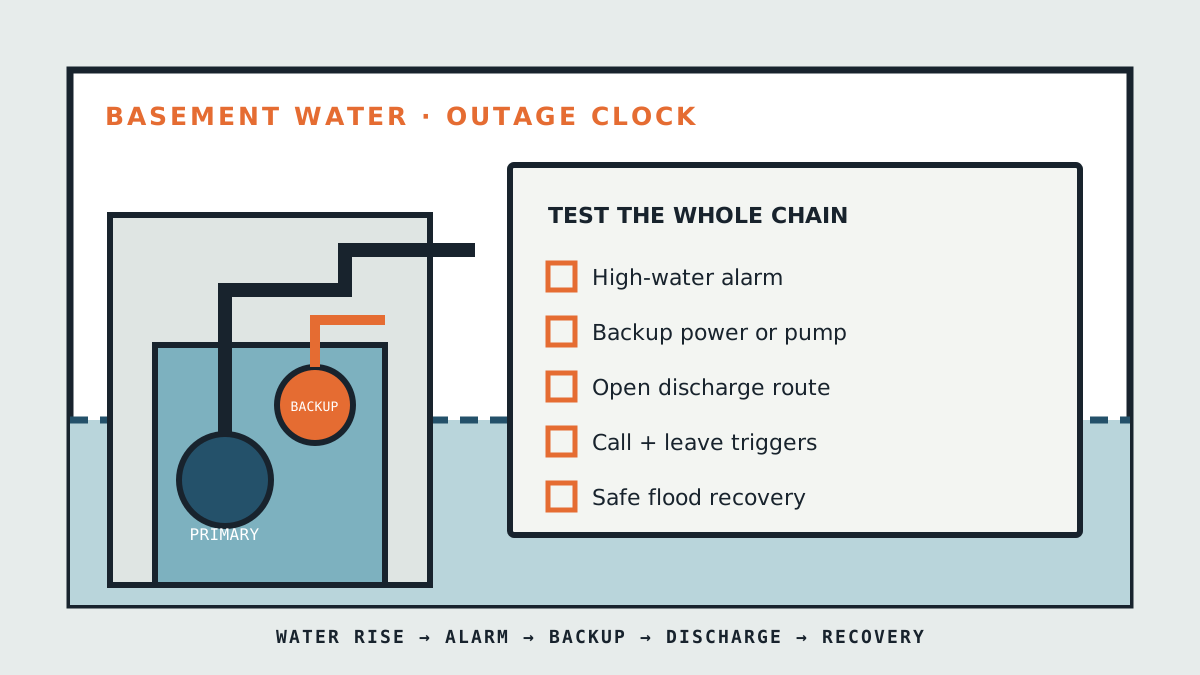
A sump pump is easy to ignore because successful operation looks like nothing happening. Water reaches the basin, the float rises, the pump sends it away, and the basement stays dry. The risk becomes visible only when one link fails: electricity, pump, float switch, check valve, discharge pipe, battery, alarm, or the route outdoors.
Public discussions often reduce the decision to “battery or generator?” The more useful question is: which failures must the plan cover, how fast can the basin fill during the worst local storm, and who will act if nobody is home? FEMA recommends a battery-operated backup for sump pumps and also identifies secondary pumps, backflow prevention, water sensors, and keeping mechanical equipment above expected water as resilience measures.
Map the chain before buying a backup
Start with what is installed. Photograph the basin from a dry, safe position and record the primary pump model, rated capacity at the actual vertical lift, float type, check valve, power circuit, discharge route, age, installer, service history, and any alarm. Do not remove a sealed cover or reach into a basin to investigate. Radon, sewage connections, sharp debris, wiring, and moving equipment can make casual inspection unsafe.
Trace the discharge to its legal outlet. A pump can run perfectly and still fail the house if a pipe is frozen, crushed, disconnected, blocked, recirculating water toward the foundation, or tied into a prohibited drain. Local codes control where water may go. EPA notes that inappropriate sump-pump connections can overload sanitary sewers; a licensed plumber and building official can confirm the correct route.
| Link | Record | Failure to plan for |
|---|---|---|
| Water entry | Foundation drains, groundwater, surface leaks, plumbing or sewer sources | Flow exceeds pump capacity or is not groundwater at all |
| Primary pump | Model, age, flow at lift, float, circuit, service contact | Motor, switch, obstruction, or breaker failure |
| Backup | Independent pump or approved power source, start level, capacity, run-time basis | Shared failure, depleted battery, no fuel, or insufficient flow |
| Discharge | Pipe route, check valve, outlet, freeze and blockage points | Water cannot leave or returns to the basin |
| Warning | Local audible alarm, remote alert, battery, test date, contact | Nobody knows water is rising |
| Recovery | Utility, plumber, electrician, restoration service, insurer | Unsafe entry or delayed drying after overflow |
Mark what sits below grade: furnace, water heater, freezer, laundry equipment, stored chemicals, paper records, outlets, extension cords, and valuables. FEMA advises elevating or relocating mechanical equipment where feasible. Move irreplaceable items now, not when water reaches the first stair.
Measure the water clock without disabling protection
No universal battery-hour promise answers the household question. A pump cycling every few minutes under light seepage is a different load from a pump running nearly continuously during saturated-ground conditions. Battery age, temperature, pump head, discharge restriction, charger health, and alarm load all affect useful run time.
Build the clock from observed, safe data. During wet weather, from a dry location, record the time between normal pump starts and the approximate run duration. Use the pump manual, installer records, and basin dimensions rather than reaching toward moving water. Ask the installer to calculate inflow and backup duration at the actual lift and discharge configuration. Write the assumptions beside the result.
Cycle interval, run time, water level at start and stop, weather, and whether the discharge is flowing freely.
Installer-confirmed inflow, pump capacity at actual head, backup capacity, battery condition, and conservative run time.
High-water level, alarm response, call order, manual intervention limit, evacuation or no-entry point.
A “five-day battery” claim without pump load and storm inflow is not a plan. Nor is assuming the basement will take hours to flood because it did last time. Soil saturation, snowmelt, drainage changes, and storm intensity alter the clock. Use the shortest credible time for response planning.
Choose backup layers that fail differently
A second standard pump on the same circuit helps with pump or capacity failure, but not a power outage. A battery-powered secondary pump can cover both primary-pump and utility-power failure if it has its own float and is maintained. A generator may power the primary pump but requires correct sizing, connection, outdoor operation, fuel, and a person or automatic system able to start it. Water-powered backups depend on an approved municipal water supply, plumbing code, backflow protection, pressure, and a lawful discharge; they are not suitable for every home.
- Local high-water alarm. Choose an alarm that works when household power and internet are down. Put it where sleeping occupants can hear it.
- Remote alert. Add cellular or another independent path only as a supplement. Wi-Fi and cloud services may fail in the same outage.
- Independent backup pump. Have a licensed plumber size and set it above the primary start level, with the required check valves and discharge arrangement.
- Backup power. Have a qualified electrician verify starting load, running load, circuit, transfer method, cords if permitted, and protection. Never backfeed a building.
- Surface-water reduction. Keep gutters, downspouts, grading, drains, and legal discharge paths maintained so less water reaches the foundation.
- Damage reduction. Raise vulnerable equipment and storage, add water sensors, and review insurance limits and any water-backup endorsement with the insurer.
A portable generator must run outdoors, at least 20 feet from the home, with exhaust directed away from doors, windows, and vents, following CDC guidance and the manufacturer. It cannot operate in a basement, garage, crawl space, porch, or shed. Connect only by an approved method and keep carbon-monoxide alarms working. The site's carbon monoxide plan covers the placement check.
Run a safe, supervised test before storm season
Use the installer’s and manufacturer’s procedure. Do not unplug a working primary pump during active rain, pour large amounts of water into an unknown system, bypass a float, open electrical enclosures, or simulate failure while alone. Schedule the test in dry weather and keep the primary protection available.
- Inspect the area from dry ground. Clear storage from the basin and discharge route without disturbing equipment.
- Test the local and remote high-water alarms using their documented test controls. Confirm who receives the alert.
- Have the qualified installer demonstrate primary and backup start levels, check valves, discharge flow, and how failure is indicated.
- Record backup voltage or condition only with the approved display or test method. Automotive batteries and improvised chargers are not a substitute unless the system specifically allows them.
- Verify that discharge reaches the lawful outlet and does not flow back toward the foundation.
- Test the approved backup-power sequence with the electrician’s instructions, including safe generator placement if applicable.
- Restore normal configuration, confirm the primary pump is powered, and record the test date, result, and correction due.
Test frequency comes from the equipment manual, installer, local conditions, and insurer—not a generic calendar. Batteries require replacement and sometimes water-level or terminal checks, but only as their manufacturer specifies. A silent alarm, corroded connection, or expired battery discovered during a dry-weather test is a useful failure.
When the power fails during heavy rain
- Start the clock. Record the outage time, rain conditions, utility estimate, and last confirmed pump cycle.
- Listen for the alarm. Check only from a dry, safe location. Do not step into water to inspect the basin.
- Reduce avoidable indoor water. If plumbing or sewer backup is part of the risk, follow utility and local instructions; do not assume groundwater is the only source.
- Use only the approved backup. Follow the written power or pump sequence. Keep generators outdoors and do not improvise connections.
- Move people first. Keep children, pets, and anyone with limited mobility away from the basement and electrical hazards.
- Call at the written trigger. Contact the plumber, property manager, utility, or emergency services before water reaches equipment—not after access becomes unsafe.
If a breaker trips, do not repeatedly reset it. A jammed pump, damaged cord, water intrusion, or motor fault may be present. Keep away and call an electrician or pump professional. Do not use a household wet/dry vacuum in standing water where electrical hazards may exist.
Set a no-entry trigger in plain language: “If water reaches the marked line,” “if the high-water alarm sounds and backup flow is not confirmed,” or “if water contacts any outlet or appliance, nobody enters.” That decision is easier to follow than “use judgment” in the dark.
Renters and travelers need a contact plan, not a pump project
Renters should not alter a building sump, discharge, electrical circuit, or backup system without authorization. Report alarm sounds, standing water, prior flooding, a blocked basin area, or an inaccessible emergency number in writing. Ask who monitors the pump, where the no-entry line is, and what to do after hours.
Before travel, owners should confirm the test date, alarm batteries, remote-alert path, neighbor or caretaker access, utility contacts, and what that person is authorized to do. A manual generator may not protect an empty home. Do not ask an untrained neighbor to enter water, open electrical equipment, or repair a pump.
Public discussions commonly reveal the unattended-outage gap: backup equipment exists, but nobody receives the alarm or can start it. The written plan should work when the most knowledgeable household member is asleep, away, or unreachable.
If water enters the basement, switch to recovery safety
Floodwater can contain sewage, chemicals, bacteria, and sharp debris. EPA advises treating the home as a potential electrical, structural, and contamination hazard. Do not enter until authorities or qualified professionals say it is safe. Photograph damage only from a safe location and follow insurer instructions without delaying emergency protection.
Electricity should be shut off only from a dry location and only when it is safe and authorized. Wet electrical equipment must be evaluated before re-energizing. If sewage backed up, follow public-health guidance and use qualified cleanup. EPA cautions that flooded septic systems have special limits; pumping at the wrong time can damage the system.
Once safe access is established, remove standing water using appropriate professional equipment, stop ongoing sources, and begin drying promptly. Porous materials contaminated by sewage or prolonged floodwater may require disposal. The EPA Flooded Home guidance explains electrical, structural, mold, and protective-equipment concerns.
After repair, determine why the chain failed: no power, dead battery, undersized backup, stuck float, blocked discharge, failed check valve, alarm not heard, surface water overload, sewer backup, or delayed response. Correct the cause with the relevant professional before calling the system restored.
Print the basement water response card
System and clock
Primary pump / install date: ___________________________
Backup type / last test: ______________________________
High-water alarm test: ________________________________
Observed wet-weather cycle: ___________________________
Installer-confirmed backup time: _______________________
Discharge outlet / freeze point: _______________________
Call and stop points
Plumber / pump service: _______________________________
Electrician / utility: __________________________________
Property manager / caretaker: _________________________
Insurer / restoration contact: _________________________
Call trigger: _________________________________________
No-entry water line: __________________________________
Post the card above basement level where it stays readable. Give the same copy to the caretaker. Run a two-minute tabletop drill: one person reads the alarm, one starts the call chain, and everyone points to the route that stays out of the basement.
Common sump-pump outage questions
Is a battery backup enough?
Only when its pump capacity, battery condition, actual storm inflow, discharge route, and conservative run time cover the planned response window. It also needs an alarm and maintenance. Have the installer document those assumptions.
Should the backup use the same discharge pipe?
That is a plumbing-design and code question. Shared and separate configurations each have requirements for check valves, capacity, routing, freezing, and lawful discharge. Use a licensed plumber and local building authority rather than copying another house.
Can I use a portable power station or UPS?
Only when the pump and power-system manufacturers explicitly support the load and a qualified electrician confirms starting surge, grounding, connection, environment, and run time. Office-style UPS units and unverified inverters may not be suitable for motor loads or damp locations.